


Illuminating the Invisible: Ultra-high Resolution Dark Matter Map of the COSMOS Field with JWST
On January 26, 2026, one of the most detailed maps ever made of dark matter was published, revealing the invisible gravitational framework that shapes the Universe. Using deep observations from NASA’s James Webb Space Telescope (JWST) as part of the COSMOS-Web survey, an international team led by Diana Scognamiglio, in collaboration with Gavin Leroy and David Harvey, traced how dark matter is distributed across a large region of the sky with unprecedented resolution.
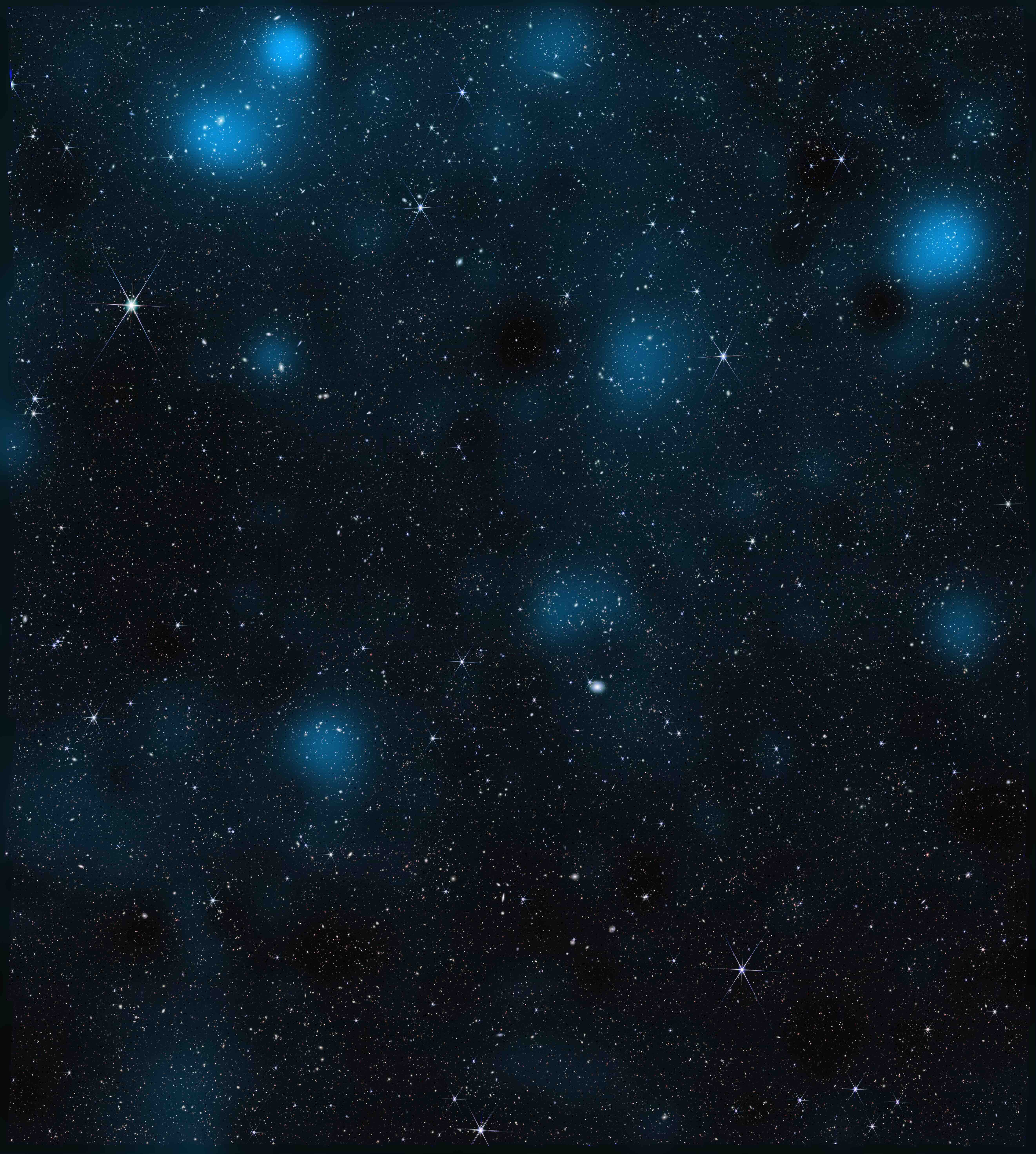
Containing nearly 800,000 galaxies, this image from NASA’s James Webb Space Telescope is overlaid with a map of dark matter, represented in blue. Researchers used JWST data to find the invisible substance via its gravitational influence on regular matter. Credit: NASA/STScI/J. DePasquale/A. Pagan
Dark matter does not emit, absorb, or reflect light and therefore cannot be observed directly. Instead, its presence is inferred through gravity. As light from distant galaxies travels through the universe, it is subtly distorted by massive structures along the line of sight — an effect known as weak gravitational lensing. By measuring these tiny distortions in galaxy shapes, astronomers can reconstruct a map of the total mass, including the unseen dark matter.
The new map focuses on the well-studied COSMOS field in the constellation Sextans, covering 0.54 square degrees of sky — about two and a half times the area of the full Moon. JWST observed this region for more than 255 hours, detecting nearly 800,000 galaxies, many of them at greater distances and fainter than previously accessible. These galaxies act as background markers, allowing researchers to trace how mass bends space itself across cosmic time.
A legacy field, revisited
The COSMOS field holds a special place in the history of weak gravitational lensing. In 2007, one of the first wide-area dark matter maps was produced using imaging from the Hubble Space Telescope, led by Richard Massey and Jason Rhodes. That pioneering work provided an early, direct view of how dark matter is distributed in a representative region of the universe.
Revisiting the same field nearly two decades later with JWST creates a natural continuity between generations of observations. JWST’s powerful near-infrared imaging reveals a far richer and more distant view of the same sky, enabling a dramatic leap forward in both depth and precision.
In the new analysis, researchers measured the shapes of roughly 250,000 distant galaxies, corresponding to 129 galaxies per square arcminute — nearly twice the density achieved with Hubble. The shapes of these galaxies are minutely distorted by foreground mass, including invisible dark matter. By averaging these distortions across many galaxies, scientists reconstruct a high-fidelity map of the underlying mass distribution, following the same fundamental approach as the original COSMOS lensing map.

Created using data from NASA’s JWST in 2026 (right) and from the Hubble Space Telescope in 2007 (left), these images show the presence of dark matter in the same region of sky. JWST’s higher resolution is providing new insights into how this invisible component influences the distribution of ordinary matter in the universe. Credit: NASA/STScI/A. Pagan
Measuring galaxy shapes in two JWST filters (F115W and F150W) further improves the accuracy of the lensing measurements. This multi-band approach increases the statistical power of the dataset and produces a sharper, more sensitive mass map than previously possible.
Revealing the cosmic web
With a spatial resolution of about 1 arcminute, the JWST dark matter map is more than twice as sharp as earlier space-based maps and far surpasses those made from the ground. It reveals a refined network of dense dark matter clumps connected by faint filaments — the intricate structure of the cosmic web. Throughout this web, dark matter forms a gravitational scaffold that ordinary matter follows as galaxies and galaxy clusters grow.
Wherever large concentrations of visible galaxies appear, corresponding concentrations of dark matter are found in the same locations. Thin bridges of galaxies connecting clusters are mirrored by invisible filaments of dark matter, showing that dark and visible matter have evolved together over cosmic history.
Why this matters
These results strengthen the picture that dark matter played a central role in shaping the universe from its earliest times. By clumping together first, dark matter drew ordinary matter into dense regions where stars and galaxies could form, ultimately creating the conditions for planets — and life — to emerge. The close alignment between dark and visible matter seen in the COSMOS-Web map provides some of the clearest evidence yet for this shared evolutionary history.
This work also lays important groundwork for future surveys. While current and upcoming missions such as the ESA’s Euclid and the NASA’s Nancy Grace Roman Space Telescope will map dark matter across much larger areas of the sky, JWST’s observations provide an unmatched high-resolution view of the universe’s invisible structure. Together, these efforts will help refine our understanding of dark matter’s nature and its role in building the large-scale structure of the cosmos.
The full publication can be found on Nature Astronomy and arXiv. For more information on COSMOS-Web, visit the program’s website. Coordinated press releases were issued by several institutes, including NASA, JPL, Durham University, EPFL, RIT, University of Cambridge, Northeastern University, UC Riverside, and Aalto University. The work also received major media coverage, including Nature’s ‘Behind the Paper’, National Geographic, Smithsonian Magazine, Scientific American, La Repubblica, NPR, and EuroNews and many more.


